Science
Can Grey Hair Be Reversed?
Can Grey Hair Be Reversed? explained with evidence, practical limits, and what it means for caring for grey hair.

Grey Hair
Science - Updated July 2026
Understand grey hair structure, texture changes, porosity, shine, dryness, and what strand behavior means for care.
Updated July 2026. We revise grey hair structure when product options, routine advice, or the supporting evidence changes. How we update guides.
Grey hair structure is the reason silver hair can look bright one day and dull the next, feel soft at the roots but dry on the ends, or stand away from the style even when the rest of the hair behaves. The phrase does not mean every grey strand is automatically coarse or damaged. It means the visible hair shaft, cuticle surface, pigment level, diameter, porosity, density, curl pattern, age, and styling history all shape how grey hair looks and feels.
Understanding structure keeps care practical. If the issue is raised cuticle, slip and lower friction matter. If the issue is mineral film on pale strands, cleansing strategy matters. If the issue is porous old permanent color, purple shampoo may not solve it. If the issue is unsupported shape, a cut may do more than another product. For the biology of pigment loss itself, read why hair turns grey; this guide focuses on the strand you can see and touch.
The visible hair shaft is a keratin fiber made by the follicle. Once it grows beyond the scalp, it is no longer living tissue. That matters because products can improve surface feel, reduce friction, add temporary conditioning, deposit tone, or change color cosmetically, but they cannot make an already-grown white strand start producing melanin.
The shaft is commonly described in layers. The outer cuticle is made of overlapping scale-like cells. Beneath it, the cortex provides much of the strand’s strength, shape, and body. Pigment granules sit mainly in the cortex when hair is pigmented. Some hairs also have a medulla, a central region that may be continuous, fragmented, or absent depending on the hair.
Grey hair appears when less pigment is incorporated into new strands during follicle growth. That pigment change alters how light moves through and reflects from the fiber. It does not automatically determine every structural property. A white strand can be fine, coarse, straight, curly, silky, brittle, high porosity, or low porosity. Color is one structural clue, not the full diagnosis.
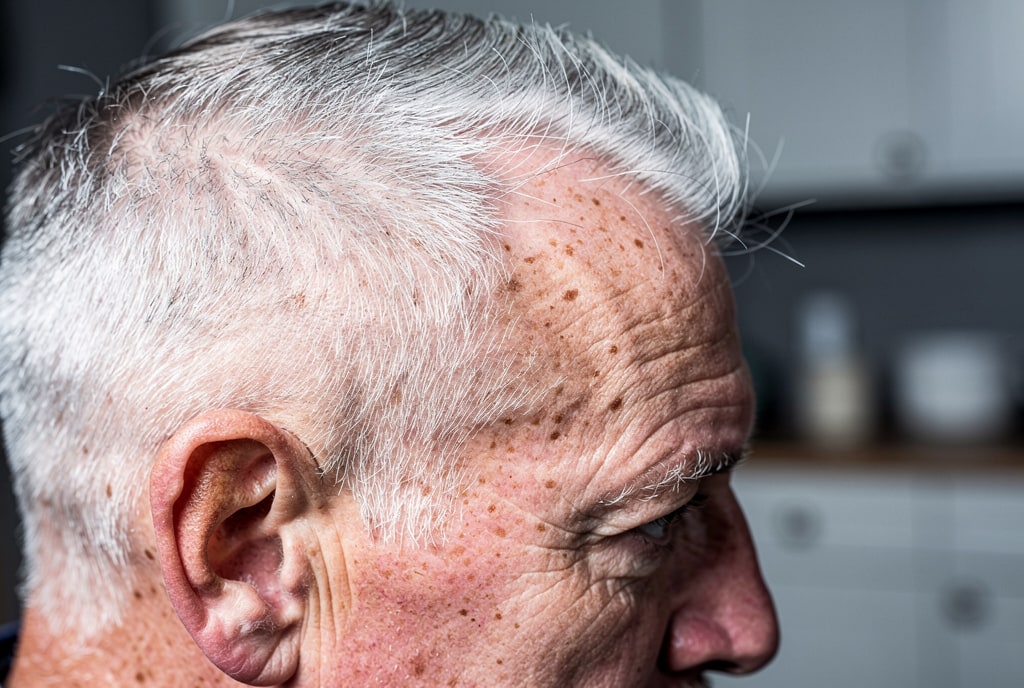
Pigment loss has a large visual effect because melanin gives hair depth and background color. When melanin is reduced, the fiber reflects and transmits light differently. Pale strands reveal surface changes that darker hair may hide. A small amount of product film, mineral residue, smoke exposure, or heat yellowing can be obvious on white hair even when the same residue would disappear visually into dark brown hair.
This is why people often say grey hair “suddenly got dull” or “turned yellow.” The follicle may not be producing yellow hair. The surface may be reflecting residue, environmental exposure, old dye, or warm indoor light. The same principle applies to shine. A smooth white strand can look luminous because it reflects light strongly. A rough white strand can look flat because light scatters from the raised surface.
Avoid assuming that every problem is “because it is grey.” Dryness may come from shampoo choice, heat, weather, old color, or not enough conditioning. Frizz may come from humidity, friction, cut shape, or curl pattern. Dullness may come from buildup. The grey color makes these issues easier to see, but the solution still depends on the cause.
Genetics influence when pigment declines, but they also influence strand diameter, curl pattern, density, oiliness, and texture. That is why two people can both be fully grey and need very different routines. One may have fine, straight, low-density silver hair that collapses under rich conditioner. Another may have dense, coily grey hair that needs generous slip, sectioned application, and moisture retention.
Timing also matters. A person who greys gradually over decades may have long experience adapting haircuts and routines. Someone who sees early or rapid greying may still be caring for the hair as if it were fully pigmented, especially if the new growth behaves differently. A transition head often contains multiple materials: untouched grey roots, old dye, highlights, lowlights, heat-styled lengths, and natural pigmented strands. The care problem is not one texture; it is a mixed-fiber system.
Do not assume your future grey hair will behave exactly like the first visible strands. Early greys are often noticed because they sit on the surface, spring away from the part, or contrast sharply with darker hair. Those noticeable pieces may not represent every grey follicle. As the proportion changes and old processed lengths are cut away, the whole head can feel different.
Grey appearance is usually created by a mixture of fibers. Some strands still contain pigment. Some are partly pigmented. Some are white or nearly white. Some are translucent enough to pick up surrounding color. The overall head can look silver, pewter, beige, white, or salt-and-pepper depending on distribution, lighting, and neighboring tones.
This mixture explains why the same head of hair can look different from day to day. Outdoor shade may make silver look cool and bright. Warm bathroom bulbs may make it look beige. Office lighting may flatten shine. Old brown dye on the ends may make new grey roots look bluer by contrast. A dark shirt may make white strands pop; a cream shirt may make them look warmer.
Because grey appearance is so light-sensitive, structural assessment should use consistent conditions. Look at the hair in indirect daylight after a normal wash and dry. Notice whether dullness remains in daylight or only under warm bulbs. Notice whether yellowing is strongest near the face, where sunscreen and skincare can transfer, or near the ends, where old dye and heat history collect. The goal is not to inspect obsessively; it is to avoid solving a lighting problem with a harsh product.
The cuticle is the surface that determines much of what people call softness, smoothness, and shine. When the cuticle lies relatively smooth and clean, light reflects more evenly and the hair feels less grabby. When the cuticle is lifted, weathered, chipped, swollen, coated, or damaged, the strand scatters light and tangles more easily. Pale hair makes that scatter obvious.
Cuticle wear can come from ordinary life: brushing, towel friction, tight elastics, high heat, sun, chemical color, bleach, hard water minerals, chlorine, and sleeping with hair rubbing against rough fabric. Grey hair that has never been dyed can still experience mechanical wear. Old dyed lengths may have much more cuticle disruption than new grey roots. This is why the ends often look dry even when roots look healthy.
Care for cuticle condition starts with handling. Detangle from the ends upward. Use enough conditioner or leave-in slip for your texture. Avoid repeated high-heat passes. Rinse products thoroughly. Clean hot tools so residue does not bake onto pale hair. Sleep in a way that reduces friction if your hair tangles overnight. Use trims when the oldest ends no longer reflect light well. These steps are not glamorous, but they match the structure.
Conditioners, leave-ins, and styling creams can improve surface feel temporarily. That is useful, but more is not always better. Too much coating can make silver hair look darker, dusty, or separated. The right amount is the amount that improves slip without hiding the natural light reflection.
Porosity describes how readily hair takes up and releases water, product, and color. High-porosity sections may absorb quickly, feel rough, dry out fast, and grab pigment. Low-porosity sections may resist water at first, let product sit on top, and look coated if formulas are too heavy. Porosity can vary across the same head, especially during a grey transition.
Uneven porosity is one reason toners and purple products surprise people. A porous white end may grab violet pigment in two minutes and look smoky or lavender, while a less porous root barely changes. Old warm dye may resist neutralizing because artificial color and underlying warmth behave differently from natural white hair. A rich conditioner may rescue porous ends but make fine grey roots look darker or flat.
The practical response is small testing. Use short contact times with pigmented products. Dilute when needed. Apply conditioner where the hair needs it most rather than automatically coating roots and ends the same way. If ends dry quickly no matter what, the structural issue may be age and damage in the oldest fiber. The focused guide on porosity and grey hair covers this in more detail.
Grey hair structure includes diameter, density, and pattern. Diameter is the thickness of each strand. Density is how much hair grows from the scalp. Pattern describes straight, wavy, curly, coily, wiry, or mixed behavior. These traits can matter more than color when choosing care.
Fine grey hair often needs lightweight conditioning, clean roots, and products that do not make the silver look darker or limp. Thick grey hair may need richer conditioning, sectioned application, and enough product to reach inner layers. Curly and coily grey hair often need more slip, less dry brushing, and refresh methods that preserve pattern. Wiry surface pieces may need conditioning plus cut support, because moisture alone cannot make an unsupported short or curved strand lie flat.
| Structure factor | What you may notice | Care response |
|---|---|---|
| Fine diameter | Roots collapse, products show quickly | Lightweight conditioner and minimal root product |
| Coarse or wiry pieces | Surface strands stand away | Moisture, lower heat, shape support |
| High porosity ends | Toner grabs, ends dry fast | Short pigment timing and regular conditioning |
| Low porosity roots | Product sits on top | Use less product and rinse thoroughly |
| Curly or coily pattern | Dry brushing disrupts shape | Wet refresh, slip, and sectioned detangling |
| Low density | Scalp shows with heavy separation | Lighter stylers and cuts that preserve movement |
Many people experience grey hair as drier, but dryness has several possible drivers. Scalp oil production can change with age. White strands may have different diameter or surface behavior. Old color and heat may have weathered the lengths. Curly and coily patterns naturally make it harder for sebum to travel from root to end. Low humidity, frequent cleansing, strong shampoos, and not enough conditioning can all contribute.
It is more accurate to ask where the dryness is. Dry roots suggest scalp or cleansing questions. Dry mid-lengths may suggest routine or environment. Dry ends often suggest age, porosity, old chemical processing, or mechanical wear. Face-framing dryness may come from sun, sunscreen, styling tools, or repeated touching. Crown dryness may involve UV exposure or friction.
The care response should match the location. Use a gentler cleanser if the whole head feels stripped. Use conditioner with more slip if detangling causes roughness. Add a leave-in to lengths if they lose softness after drying. Reduce heat if hair feels rougher after styling. Trim if the ends never improve. The guide to why grey hair dries is the best next step for this specific concern.
Yellowing is often a surface or environmental issue, not proof that the hair is permanently yellow. Minerals in water, smoke, air pollution, chlorine, sunscreen, self-tanner, heat exposure, and product residue can all shift pale strands. Old color can also leave warm ends that do not match cooler grey roots. Because white hair has little background pigment, small deposits are easier to see.
Before reaching for a strong purple shampoo, identify the likely source. If the hair feels coated, clarify or address hard water. If you swim, rinse before and after pool exposure and cleanse promptly. If heat styling is frequent, lower the temperature, use heat protection, and clean the tool. If sunscreen transfers to face-framing hair, adjust application and cleanse those pieces well. If old dye is warm, a stylist may need to tone, gloss, blend, or cut; one shampoo may not be enough.
Purple products are useful when the visible problem is yellow tone. They are not a cure for rough cuticle, dryness, or old permanent dye. Used too often, they can make white hair look flat, smoky, or violet. For more detail, use brassiness causes and keeping silver tone.
During a grey transition, one head can contain natural grey roots, pigmented natural hair, old permanent color, highlights, lowlights, porous ends, and heat-styled lengths. These materials do not respond the same way. The roots may need light product and scalp comfort. The ends may need richer conditioning and trims. Old dye may need salon correction. Natural white strands may need only gentle tone maintenance.
This is why one-step routines often disappoint. A conditioner that makes processed ends feel better may weigh down new grey roots. A purple shampoo that cools white pieces may leave old brown dye unchanged. A gloss that adds shine may not fix split ends. A cut that removes old porous length may do more for structure than months of product changes.
The stages of going grey guide explains the visual phases, but structurally the key is this: do not judge the future of your natural grey by the behavior of damaged old ends. Once processed length is cut away, the new grey may feel softer, lighter, curlier, straighter, or simply more consistent.
A structure-aware routine starts with the least dramatic steps: cleanse enough to keep the surface clear, condition enough to reduce friction, and style in a way that supports the haircut and texture. Add targeted steps only when the hair asks for them. This prevents the common cycle of using more products to solve buildup caused by too many products.
For many grey heads, a practical routine includes a gentle cleanser, a conditioner matched to density and texture, a leave-in only where tangling or dryness persists, heat protectant when hot tools are used, and occasional toning only when yellow cast appears. Fine hair may need conditioner mostly on the ends. Coily hair may need sectioned conditioning and careful detangling. Short wiry hair may need a cut that works with growth direction more than a heavy cream.
Product categories should answer structural problems. A conditioner should improve slip without flattening silver roots. A heat protectant should reduce styling stress without yellowing or stiffening. A purple shampoo should be used for unwanted warmth, not as a daily cleanser by default. The everyday version is mapped in daily care for grey hair.
Grey hair products often use strong words. Some are reasonable when read cosmetically; others imply more biology than the evidence supports. “Smooths” or “adds slip” can be true if a conditioner coats the cuticle and reduces friction. “Strengthens” may mean temporary film-forming support or reduced breakage during combing. “Repairs” may mean improved feel, not restoration of the original internal structure. “Reverses grey” is a much stronger claim about follicle pigment.
| Claim | Evidence-bound reading | What to ask before trusting it |
|---|---|---|
| Repairs grey texture | May smooth or condition the surface | Is the result temporary feel or measured fiber change? |
| Reverses grey hair | Implies new pigment production | Was objective repigmentation shown in comparable people? |
| Detoxes silver hair | May mean stronger cleansing or chelation | What is removed, and is it safe for your hair and scalp? |
| Seals porosity | May reduce water exchange temporarily | Does it improve your ends without coating roots? |
| Strengthens aging hair | May reduce breakage during grooming | Was breakage measured, or is it only shine and feel? |
| Adds melanin support | Names pigment pathways | Does the finished product change new growth? |
This approach is not anti-product. It protects useful products from impossible expectations. A good leave-in can make grey hair easier to detangle. A toner can improve a warm cast. A trim can remove ends that no formula can make behave like new growth. Those are real outcomes even when pigment is unchanged.
Care cannot change inherited greying timing, restart melanin in the visible shaft, or permanently change strand diameter. It cannot make heavily damaged ends behave like untouched roots. It cannot erase every effect of years of bleach, permanent dye, heat, sun, or friction. It cannot replace medical care for scalp symptoms, sudden shedding, or patchy color loss.
These limits are useful. If a white strand is healthy but coarse, the answer may be a cut and styling method, not endless moisture. If ends are transparent and rough after years of color, the answer may be trims, not a stronger mask. If yellowing comes from hard water, the answer may be water and cleansing strategy, not more violet pigment. If the scalp hurts, flakes, or sheds, the answer is not a styling cream.
Care can improve feel, shine, manageability, friction, and the way hair sits in a shape. It can reduce avoidable breakage. It can keep silver brighter by preventing buildup. It can make a grow-out look more intentional. The boundary between cannot and can is where frustration turns into a plan.
Texture change alone is often cosmetic, especially when it appears gradually with greying, aging, or old color history. Seek medical care when structural or color change is sudden, patchy, associated with increased shedding, scalp pain, scaling, sores, redness, burning, itching, or broader symptoms such as fatigue, weight change, skin pigment change, or signs of deficiency. A dermatologist or primary care clinician can decide whether testing or treatment is appropriate.
Medical care and salon care answer different questions. A clinician can evaluate scalp disease, alopecia, vitiligo, inflammation, deficiency, medication effects, or other health factors. A stylist can help with tone, blending, cut, porosity, old dye, and product fit. If a brand encourages you to treat sudden shedding or scalp pain with a cosmetic grey-hair product instead of seeing a professional, that is a reason to pause.
It is also reasonable to seek help if texture or color change is affecting self-image strongly. Distress does not prove disease, but it deserves support. Evidence-bound care should make room for both: normalizing grey hair as common biology and recognizing that sudden or symptom-linked changes need a medical lens.
When trying a product on grey hair, judge it against the structure problem you actually have. If the problem is rough cuticle, ask whether the hair feels smoother and tangles less. If the problem is high porosity, ask whether the ends stay soft after drying. If the problem is yellow tone, ask whether the color looks cleaner in daylight without turning smoky. If the problem is fine density, ask whether the product preserves movement.
Use a small test area when pigment or heavy styling products are involved. White and porous pieces can show mistakes quickly. A product that looks beautiful on thick silver hair may collapse fine silver hair. A formula that controls wiry surface strands may make low-density roots look oily. Structure determines fit more than the label does.
Give each test a fair but limited window. A purple shampoo should show tone change quickly; if it does not, the issue may not be yellow tone or the contact time may be wrong. A conditioner should improve slip during and after rinsing; if the hair feels coated by the second wash, it may be too heavy. A leave-in should reduce friction without making the silver look dusty. A styling cream should support shape without hiding movement. The point is to learn from the result, not to keep adding steps until the routine becomes the problem.
Keep notes in ordinary language: “ends tangle less,” “roots look flat,” “front pieces turned smoky,” “hair feels rough after heat,” or “looks best on day two.” Those observations are more useful than repeating a marketing label. They also help a stylist understand the material they are working with if you later ask about a gloss, toner, blending service, or cut.
You do not need a lab to make better care decisions, but you do need consistent observation. After a normal wash, let the hair dry in the way you usually wear it. Look in indirect daylight. Then ask five questions: Does the hair feel rough, coated, dry, limp, or unsupported? Where does that happen: roots, mid-lengths, ends, crown, or face frame? Does water wet the section easily or bead at first? Do pigmented products grab quickly? Does heat make the problem worse?
These questions point toward different responses. Roughness suggests cuticle wear, friction, or porosity. A coated feeling suggests product amount, hard water, or cleanser mismatch. Dry ends suggest age, processing, or moisture routine. Limp roots suggest weight or low density. Unsupported pieces suggest cut, growth direction, or styling method. A section that grabs toner quickly should be treated more cautiously than a resistant section.
Avoid turning at-home checks into harsh experiments. Floating a strand in water or running fingers up and down one hair can be misleading because product residue, diameter, and damage all affect the result. The useful test is how your whole head behaves in the routine you actually use. Structure is a pattern, not a trick performed by one strand.
Grey hair changes dramatically with lighting, so photos are part of structural assessment. Take one set in indirect daylight after a normal wash and dry. Take another after a week of your usual routine. If the hair looks yellow only under warm bulbs, it may not need tone correction. If the ends look transparent in every light, the cut may need attention. If the surface looks rough after heat but smoother after air-drying, styling stress is part of the structure story.
Photos also help during transition. New grey roots may look healthier than old processed ends, but the contrast can make the whole style feel inconsistent. Seeing the difference clearly helps you choose trims, conditioning, or salon blending instead of blaming the natural grey.
Use photos to protect yourself from over-correction. Pale hair reflects the room, the wall color, clothing, and camera settings. A single warm photo is not proof that you need more violet pigment. A single shiny salon photo is not proof that a product changed the fiber permanently. Compare similar light, similar styling, and similar wash timing. If the hair looks clean and bright in daylight but beige under one lamp, change the lamp before changing the whole routine.
Trims are structural maintenance. They remove ends that have the most history: old color, heat, friction, sun, and mechanical wear. Products can temporarily smooth those ends, but they cannot make severely weathered fiber behave like new growth. Regular trims also improve how light reflects from the perimeter, which is especially visible on silver hair.
A trim does not have to mean abandoning length. Even small, scheduled removals can keep grey hair from looking dry at the bottom. If every routine works at the roots and fails at the ends, the structure problem may be age and damage in the oldest hair, not a missing product.
Shape is part of structure too. A blunt line can make fine silver hair look denser, but it may feel heavy on thick hair. Layers can free waves and curls, but too many short pieces can create a halo of bright flyaways. Short cuts can look intentional and polished, but they need to respect growth direction, cowlicks, and wiry pieces. Long grey hair can be beautiful, but the ends have to be maintained because pale fiber shows weathering clearly. A good cut does not change pigment; it changes how the material is supported.
Bring structural language to salon appointments. Instead of saying only “my grey hair is bad,” describe what happens: “the white ends grab toner,” “the roots go flat with conditioner,” “the face frame yellows,” “the crown feels rough after heat,” or “the old dye stays warm.” Those details help a stylist choose between toner, gloss, chelating, conditioning, blending, trims, or cut changes.
Ask whether a proposed service is correcting tone, smoothing reflection, removing buildup, blending old color, or changing shape. Ask how porosity affects timing. Ask what home care is supposed to do after the appointment. Ask what cannot be fixed without cutting old damage. These questions keep expectations realistic and make salon work more collaborative.
If a stylist suggests a pigment-restoration product, use the same evidence standard you would use for any other claim. Is it cosmetic color? Is it a temporary stain? Is it a scalp treatment for a diagnosed condition? Or is it a broad promise to reverse grey hair? Clear categories protect both your hair and your budget.
Grey hair structure is a mix of pigment loss, cuticle condition, porosity, diameter, density, texture, age, and history. Once you understand which factor is driving the problem, the routine becomes simpler. Tone yellow hair. Condition dry hair. Clarify coated hair. Protect heat-styled hair. Cut unsupported ends. Seek medical care for sudden, patchy, painful, inflamed, or symptom-linked change.
The most useful grey hair care is not built around fear of silver strands. It is built around the material in front of you. Pale hair shows residue, roughness, and lighting shifts more clearly, but it can also look unusually bright when the surface is clean and the cut supports the texture. For pigment biology, read why hair turns grey. For practical routines, use daily care for grey hair and the broader science hub.
Grey hair can behave differently because pigment is reduced and strand diameter, cuticle condition, previous damage, and aging-related changes all affect feel and shine.
Grey hair may feel wiry because pale strands are more visible, the cuticle may be rough, the strand may have a different diameter, or old color and heat damage may affect the lengths.
Care cannot change genetics or restore pigment, but it can improve surface feel, reduce friction, support shine, and protect the strand from avoidable damage.
Yes, porous white or processed sections can absorb toning pigment quickly, so short contact times and strand tests are safer than assuming all grey hair responds evenly.
Seek medical care when texture change comes with sudden shedding, patchy color loss, scalp pain, scaling, sores, inflammation, or other health symptoms.
Can Grey Hair Be Reversed? explained with evidence, practical limits, and what it means for caring for grey hair.

Genetics explained with evidence, practical limits, and what it means for caring for grey hair.
Hydrogen Peroxide and Grey Hair explained with evidence, practical limits, and what it means for caring for grey hair.
Grey hair care notes — transition tips, science, and silver routines