Science
Can Grey Hair Be Reversed?
Can Grey Hair Be Reversed? explained with evidence, practical limits, and what it means for caring for grey hair.
Grey Hair
Science - Updated July 2026
Learn why hair turns grey, what pigment loss means, which claims to question, and how the science changes everyday care.
Updated July 2026. We revise why hair turns grey when product options, routine advice, or the supporting evidence changes. How we update guides.
Hair turns grey when a follicle adds less pigment to new hair as it grows. The visible result can be silver, white, steel grey, salt-and-pepper, or almost translucent depending on the mix of pigmented and unpigmented strands, the light around you, strand diameter, and the condition of the hair surface. That basic mechanism is more useful than most dramatic claims because it separates biology from cosmetics: a product can make grey hair look brighter, softer, or cooler in tone without changing why the next strand emerged grey.
This guide explains what is established, what is plausible but still being studied, and what deserves skepticism. Normal greying is not a disease, and choosing to color it is not a failure. The practical goal is to understand pigment loss well enough to make calmer decisions about care, color, nutrition claims, stress myths, and when a medical professional should be involved. For the broader article library, start at the science hub; this page focuses on why the color changes in the first place.
Hair color is built during growth, not painted onto the strand after it leaves the scalp. Inside a growing follicle, pigment-producing cells called melanocytes make melanin and transfer pigment to the developing hair fiber. Eumelanin contributes brown and black tones, while pheomelanin contributes red and yellow tones. Your natural color comes from the amount, type, and distribution of those pigments, shaped by genetics and follicle behavior.
When a follicle adds less melanin to a new strand, that strand looks lighter. When very little pigment is added, it may look white. This is why grey roots appear at the scalp first and why an already-grown dark hair does not usually fade to grey along its full length overnight. The visible shaft is dead fiber; it can be cleansed, conditioned, toned, dyed, coated, or damaged, but it cannot restart melanin production along its length.
The living follicle still matters. Scalp inflammation, medical conditions, nutritional deficiencies, oxidative stress pathways, and follicle aging can all be discussed because the follicle is biologically active. But those are not the same as a shampoo, oil, or supplement reliably restoring natural pigment across the scalp. Any claim about reversing grey hair has to show that follicles made and transferred more pigment into new hair, not merely that existing hair looked darker after a cosmetic treatment.
Researchers sometimes describe a “hair follicle pigmentary unit”: the local system that produces hair pigment during the active growth phase. In plain language, it is the pigment workshop inside the follicle. Melanocytes, nearby keratin-forming cells, follicle cycling, stem cell reservoirs, signaling molecules, and oxidative balance all influence whether a growing strand receives enough pigment.
That unit behaves differently from skin pigment. Skin melanocytes help protect and color the skin continuously. Hair pigment production is tied to the hair cycle. A follicle goes through active growth, regression, rest, and re-entry into growth. Pigment is mainly added during active growth. This cycling helps explain why grey hair usually appears as new growth from specific follicles rather than as a uniform wash over every hair already on the head.
The most evidence-bound summary is simple: greying reflects reduced pigment production and transfer in the follicle, often involving melanocyte aging, melanocyte stem cell availability, and local oxidative stress. Those mechanisms are real biology. What is not established is the consumer leap that because a pathway exists, any product naming that pathway can restart it. Mechanisms suggest research questions; they do not automatically prove at-home results.
Genetics strongly shape when greying becomes visible. Family pattern is often one of the best clues: if close relatives greyed early, earlier greying may be part of your inherited pattern rather than a sign that you did something wrong. Genes influence pigment type, follicle biology, antioxidant systems, and the timing of pigment-cell decline. They also influence the background color that makes new grey strands easy or hard to notice.
Age still matters, but there is no single timeline. Some people see silver in their twenties. Others keep most of their natural color much later. Some grey first at the temples; others notice the crown, beard, brows, sideburns, or scattered strands throughout the head. A pattern can feel sudden when the number of white strands crosses your attention threshold, even if the underlying process has been developing gradually strand by strand.
Ethnicity and natural hair color affect visibility and averages, but they do not predict one person’s exact path. A few white strands stand out sharply against black or dark brown hair. They may be almost invisible against very light blonde hair. Dense hair may hide early greying longer than low-density hair. Curly hair may reveal or hide silver depending on how the strands clump. These visible factors are not trivial; they shape the moment you perceive the biology.
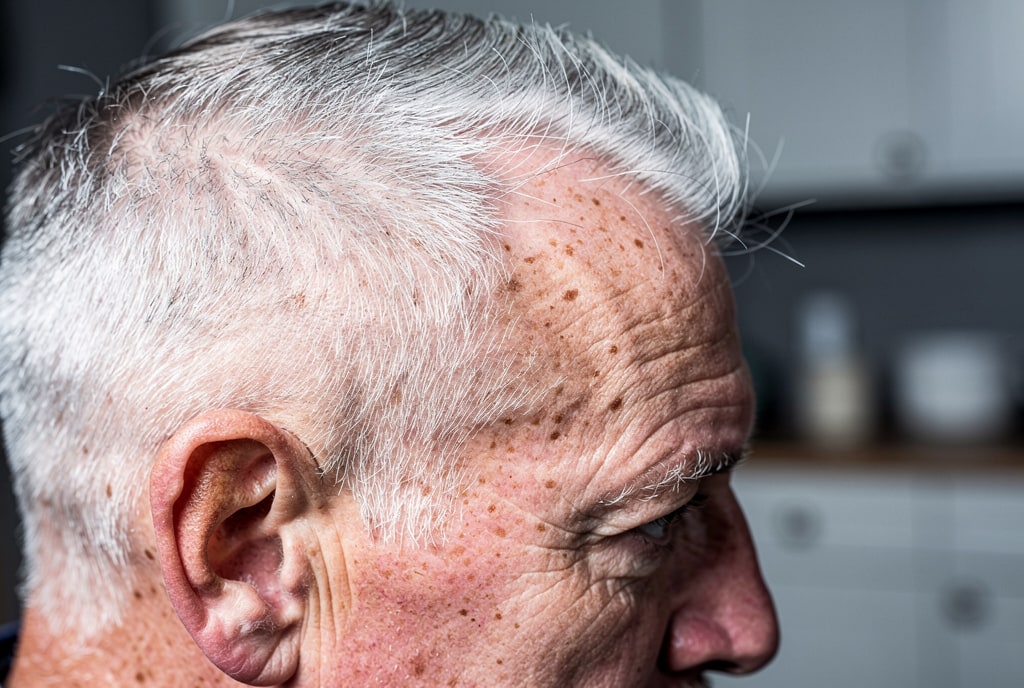
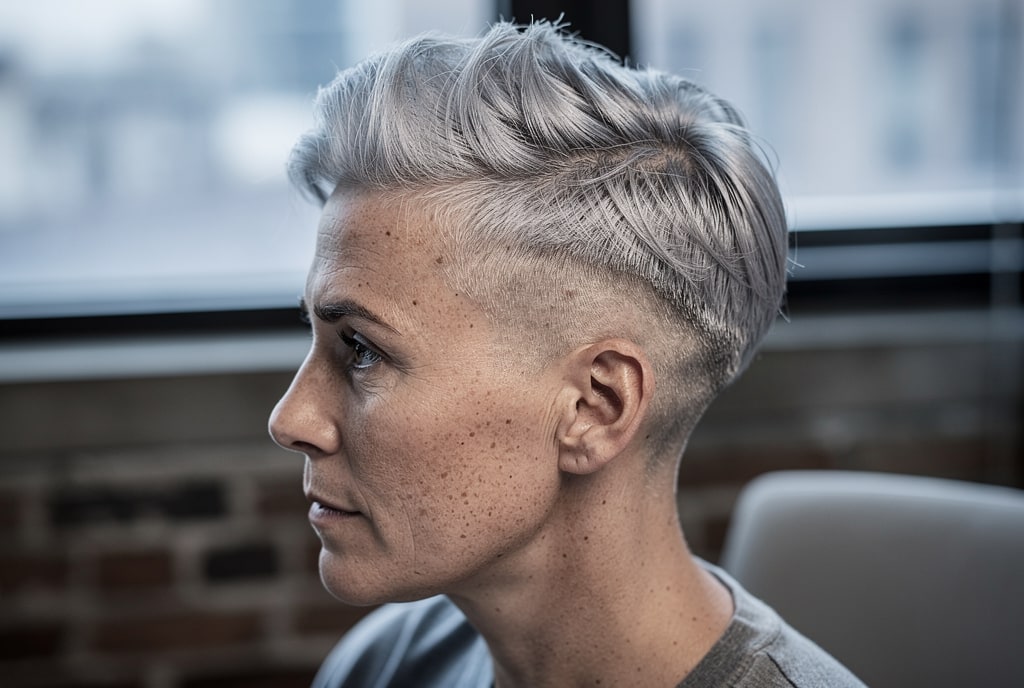
“Grey hair” is usually a visual average, not a single fiber color. A head of grey hair often contains pigmented brown, black, blonde, or red strands; partly pigmented strands; white strands; and translucent strands that reflect surrounding light. From a distance the mix reads as grey, silver, pewter, or salt-and-pepper. Up close, it is a mosaic.
Lighting changes that mosaic dramatically. White strands can look silver outdoors, yellow under warm bathroom bulbs, beige next to old dye, blue-toned in cool light, or flat under office lighting. Camera flash can exaggerate contrast. A mirror near a window may show a different shade than a phone photo indoors. This does not mean the follicle changed pigment that day. It means pale fibers reveal the light environment more clearly.
Surface condition also changes appearance. Minerals in water, smoke, chlorine, sunscreen transfer, self-tanner, air pollution, heat exposure, and product film can sit on pale strands and create a yellow, beige, dull, or darker cast. That is different from the follicle producing yellow hair. The response might be cleansing, chelating, lower heat, rinsing after swimming, or adjusting product amount. Over-toning a buildup problem can make white hair look smoky or violet without solving the cause.
The common story that someone “went grey overnight” is usually not literal pigment disappearance from every existing strand. Hair shafts do not normally dump melanin along their length in a single night. What can happen is a shift in visibility, a new parting, a haircut that exposes white roots, a period of intense scrutiny, or a shedding event that changes the ratio of pigmented to unpigmented hairs.
There are rare medical situations where rapid changes in apparent color can occur because pigmented hairs are shed preferentially while white hairs remain more visible. That is not the same mechanism as ordinary gradual greying, and it belongs in a medical conversation. For most people, the overnight story is a myth built from real distress, lighting, observation, and timing.
This distinction matters emotionally. Stressful life events often make people inspect their hair more closely, and a first cluster of silver can feel like evidence that the body has changed all at once. It may be more accurate to say the pattern became noticeable all at once. If you want help separating myths from biology, the grey hair myths hub and the guide to stress turning hair grey overnight address that story directly.
Stress and hair biology are connected, but the evidence does not support simple blame. NIH-highlighted research in mice showed that acute stress can affect melanocyte stem cells through sympathetic nervous system signaling. That is important because it identifies a plausible biological route: stress pathways can influence the pigment system in follicles. It does not prove that every stressful month causes permanent grey hair in humans, and it does not prove that a consumer product can reverse stress-related greying.
Human lives are messy. Age, family history, smoking, health conditions, sleep disruption, diet, medication changes, inflammation, and observation bias can overlap with stressful periods. If grey appears during a hard year, stress may be part of the context, but it is rarely the only evidence-based explanation. Blaming yourself for grey hair is not a scientific conclusion.
The most reasonable advice is health-focused rather than pigment-obsessed: manage stress for sleep, cardiovascular health, mental health, and general wellbeing. If stress is paired with shedding, scalp symptoms, weight changes, fatigue, or other signs, seek medical care. Be skeptical of products that translate stress research into “reverse your grey” promises without showing objective repigmentation in the intended users. For a narrower evidence review, see stress and grey hair research.
Nutrition supports normal hair growth, but nutrition is not a universal grey-hair cure. Deficiencies in nutrients such as vitamin B12 or iron can be associated with hair and health changes, and some medical sources discuss deficiency evaluation in premature greying. That does not mean everyone with grey hair should start high-dose supplements or stacks of “melanin support” capsules.
A supplement can help only when it addresses a real need. If a person has a documented deficiency, treating it under medical guidance may support health and sometimes hair quality. If a person is not deficient, adding large doses may be useless, expensive, or risky. Some nutrients interact with medications or cause harm at high intake. Hair color claims need especially strong evidence because repigmentation is a stronger claim than “supports general hair health.”
Read supplement claims by asking what was studied. Was the population actually deficient? Was pigment measured objectively? Did new hair grow in with more natural pigment, or did existing hair look darker from a cosmetic effect? How long was the follow-up? Were results compared with a control group? A brand naming melanin pathways is not enough. The companion piece on nutrition evidence and grey hair goes deeper into this boundary, and the myth guide on vitamin cures is useful for quick claim-checking.
Oxidative stress is often mentioned in grey hair research because pigment production is chemically active and follicles must manage reactive molecules. Some studies have examined hydrogen peroxide buildup, antioxidant enzyme changes, mitochondrial stress, and damage within the pigmentary unit. These are legitimate research topics, and they help explain why greying is considered a visible model of aging in a small, accessible organ.
The tricky part is translation. “Oxidative stress is involved” does not mean an antioxidant shampoo, oil, pill, or scalp serum will restore your previous hair color. The follicle is not a simple container waiting for one ingredient. Pigment production depends on cell populations, signaling, follicle cycling, genetics, local microenvironment, and time. An ingredient can be interesting in a lab and still fail to change hair color in real consumers.
This is where evidence-bound language protects readers. It is fair to say oxidative pathways are part of the science. It is too strong to say grey hair is simply caused by lacking one antioxidant. It is fair to support a balanced diet, smoking avoidance, scalp comfort, and sun-aware habits. It is too strong to promise that antioxidants will reverse established greying. If a treatment claim centers on hydrogen peroxide or melanin enzymes, ask for finished-product human evidence, not just a pathway diagram.
“Premature greying” describes timing, not a single cause. It can be inherited, associated with ethnicity-specific expectations, linked with medical conditions, or simply noticed earlier because the contrast is high. People under 30 often experience it as a social and identity issue as much as a biology issue. That emotional weight deserves respect without turning every early silver strand into an emergency.
Family history helps sort the first level of concern. Gradual early greying with a strong family pattern is often different from abrupt, patchy, or symptom-linked change. Still, early greying can be worth discussing with a clinician when it appears very young, progresses quickly, or arrives with fatigue, hair loss, scalp symptoms, menstrual changes, weight change, digestive symptoms, or other health signs. A clinician can decide whether evaluation for deficiency, thyroid disease, autoimmune disease, medication effects, or other factors is appropriate.
The site’s premature greying causes guide covers the practical decision tree. The key point here is humility: biology has multiple inputs, and the mirror cannot diagnose them. A gradual family pattern may call for care and styling support. A sudden or medically complicated pattern calls for evaluation.
Pigment loss changes appearance, but grey hair feel is not determined by color alone. Many people describe grey hair as wiry, dry, coarse, resistant, or unruly. Sometimes individual grey strands have a different diameter or shape. Sometimes they simply catch light more strongly, making texture more visible. Often, the rough feeling comes from cuticle wear, heat styling, old permanent color, brushing friction, sun exposure, or dryness rather than from the absence of pigment itself.
The hair shaft has an outer cuticle and an inner cortex. When the cuticle lies smoother, light reflects more evenly and the hair tends to feel softer. When the cuticle is lifted, weathered, coated, or damaged, pale strands show dullness quickly. Porosity also matters. Porous white ends may absorb toner or purple shampoo quickly and turn smoky, while less porous roots barely change. Old dyed lengths may be warmer, rougher, and more porous than new grey growth.
This is why the right care question is structural, not moral. Is the hair coated? Clarify gently. Is it dry? Condition and reduce friction. Is it yellow? Identify whether the cause is minerals, heat, smoke, sunscreen, old dye, or tone. Is it breaking? Reduce heat and mechanical stress. The article on grey hair structure and the guide to why grey hair dries go deeper into these care implications.
Care can change the look and feel of grey hair in meaningful ways. It can remove buildup that makes white strands look beige. It can add slip so hair tangles less. It can reduce friction during detangling. It can lower heat exposure. It can help curls clump, fine hair keep movement, or wiry pieces sit better in the style. It can tone yellow cast when the problem is truly unwanted warmth.
Care cannot make an already-grown white strand produce melanin. It cannot reliably change inherited timing. It cannot make heavily processed ends behave like untouched roots. It cannot replace medical care for sudden shedding, scalp inflammation, or deficiency symptoms. These limits are not discouraging; they prevent wasted effort.
For daily routines, start with gentle cleansing, conditioner matched to your density and texture, heat protection when needed, and tone products only when tone is the issue. If you are transitioning, treat new grey roots and old dyed lengths as different materials. If you are fully grey, maintenance is usually about brightness, softness, shape, and scalp comfort. The daily care for grey hair guide translates this biology into a routine.
Grey hair marketing often borrows scientific language. That does not make every product dishonest, and it does not make every product useful. The best test is whether the claim names a cosmetic effect or a biological effect. “Neutralizes yellow tone” is a cosmetic claim. “Adds slip” is a cosmetic claim. “Improves shine” is a cosmetic claim. “Restores natural pigment” is a biological claim and needs much stronger evidence.
| Claim | What it may really mean | Evidence question |
|---|---|---|
| Brightens grey hair | Removes residue or deposits violet tone | Is the effect cleansing, toning, or both? |
| Supports melanin | Names an ingredient tied to pigment biology | Did the finished product increase natural pigment in new growth? |
| Reverses grey | Promises follicle repigmentation | Was objective repigmentation shown in comparable people? |
| Repairs grey texture | Smooths, coats, conditions, or reduces friction | Is the result temporary feel or true fiber repair? |
| Fights stress greying | Uses stress research in marketing | Was stress-related human greying actually measured? |
| Detoxes grey hair | May mean stronger cleansing | What substance is removed, and is the method safe for hair and scalp? |
This framework keeps room for useful products. A purple shampoo can be valuable when yellow tone is the problem. A conditioner can be valuable when tangling is the problem. A salon gloss can be valuable when reflection and tone need help. The problem is not cosmetics; the problem is selling cosmetics as follicle biology. For reversal claims specifically, read can you reverse grey hair?.
Understanding pigment loss makes salon conversations clearer. A stylist can cover grey, blend it, tone it, gloss it, lowlight it, highlight around it, or help grow it out. Those services work on visible hair. They can change how grey is seen, how old dye meets new growth, and how reflective the surface looks. They do not restart pigment production in the follicle.
Ask which material the service is addressing. Is the goal to cover new growth, soften the line of demarcation, cool warm old dye, add shine, or reduce contrast? Ask what happens as roots grow. Ask whether home care is for tone, moisture, buildup, or damage prevention. Ask how porosity will affect toner timing. These questions prevent disappointment because they match the service to the actual mechanism.
If you are moving from dye to natural grey, the structural and emotional issues overlap. Old color may be porous and warm while new grey is cooler and healthier. A grow-out plan may involve trims, glosses, blending, patience, or a decisive cut. For practical planning, the grow-out plan and salon consultation guides are more useful than searching for a cure.
Gradual greying is common and usually does not require medical treatment. Seek professional input when greying is sudden, patchy, very early without family pattern, or accompanied by hair shedding, scalp pain, scaling, sores, itching, redness, fatigue, weight change, new medications, skin pigment changes, or other symptoms. Also seek guidance before taking high-dose supplements or using aggressive scalp products marketed as pigment treatments.
Medical care and cosmetic care answer different questions. A clinician can evaluate whether a health factor may be involved and whether testing is appropriate. A dermatologist can assess scalp disease, alopecia, vitiligo, inflammation, or other skin and hair conditions. A stylist can help with tone, coverage, blending, shape, and maintenance. One role does not replace the other.
It is also reasonable to seek care for the emotional impact if grey hair causes significant distress, anxiety, or avoidance. Normal biology can still affect self-image. Evidence-bound advice should not dismiss that. It should simply avoid turning fear into a marketplace for unsupported cures.
One white strand does not reveal the entire future of your hair. A single hair may stand out because of contrast, part placement, lighting, or the way it reflects against darker strands. A cluster at one temple may reflect a family pattern. A bright piece near the part may be visible because it sits on the surface. Biology happens follicle by follicle before it reads as a head-wide pattern.
Documentation is more useful than daily inspection. If you are worried, take monthly photos in similar indirect daylight, with the same part and style. Look for pattern: gradual, clustered, patchy, or changing quickly. Pulling, plucking, and checking individual strands usually increases anxiety without improving information. If the pattern is gradual, the next step is usually care, styling, color planning, or acceptance. If it is sudden or patchy, the next step is medical advice.
This approach also helps with product trials. Do not judge a supplement, toner, or routine by one flattering bathroom photo. Use consistent lighting and enough time to separate actual change from reflection, buildup, or styling.
Normal greying can be emotionally complicated without being pathological. It can change how people read your age, identity, gender presentation, professional image, or family resemblance. Those meanings are real. But treating every grey hair as a defect to cure can make ordinary aging feel like personal failure and can make weak claims more persuasive than they deserve to be.
The evidence-aware position is generous: color your hair if you like the look, blend it if you prefer softness, grow it out if that feels freeing, and care for it if you want brightness and comfort. None of those choices needs a false medical story. Grey hair is a visible sign of follicle pigment change, shaped heavily by genetics and time. It can be cared for, styled, colored, celebrated, or ignored.
Science is useful because it narrows the promise. It tells you when a claim is cosmetic, when a claim is biological, and when a clinician is the better next step. It also makes room for ordinary preference. You do not have to love grey hair to reject cure myths, and you do not have to reject color to understand the biology.
Hair turns grey because pigment production and pigment transfer decline in the follicle, especially within the follicle’s pigmentary system during new hair growth. Genetics strongly shape timing, while age, health context, stress biology, nutrition status, and environment can influence the conversation in specific ways. The visible result depends on the mixture of strands plus light, surface condition, porosity, and old color history.
Use that science to set expectations. Care can improve tone, softness, shine, friction, scalp comfort, and manageability. Salon work can cover, blend, tone, or transition grey hair. Supplements may matter when a real deficiency is present, but they are not universal pigment restorers. Stress research is real, but overnight myths and reversal guarantees overstate what ordinary consumers can conclude. If change is sudden, patchy, symptom-linked, or worrying, seek medical care. If it is gradual, continue with grey hair structure or daily care for grey hair to turn the biology into practical care.
Hair turns grey when pigment production and pigment transfer in the follicle decline, leaving strands with less melanin and a lighter visible appearance.
Age is common, but genetics, follicle biology, and some health factors can influence timing. Sudden or patchy change should be discussed with a clinician.
Cosmetic products can change tone, shine, and softness, but they should not be treated as proven ways to restore natural pigment across the scalp.
Stress biology can affect follicles, but the common overnight story is misleading because visible shafts do not suddenly lose all pigment along their length.
Seek medical care for sudden, patchy, very early, or symptom-linked change, especially with shedding, scalp inflammation, fatigue, or other health changes.
Can Grey Hair Be Reversed? explained with evidence, practical limits, and what it means for caring for grey hair.

Genetics explained with evidence, practical limits, and what it means for caring for grey hair.

Understand grey hair structure, texture changes, porosity, shine, dryness, and what strand behavior means for care.
Grey hair care notes — transition tips, science, and silver routines